Sex Differences in MTG Astrocytes (IPRE, Winter 2026)
- Student: Emilia Magni (IPRE, Winter 2026, July to August, 100 hours)
- Supervisor: Tomás González Zarzar
- Data: SEA-AD snRNA-seq, middle temporal gyrus (MTG), 84 donors
- Status: finished as an IPRE project. Exploratory; see Caveats before using any of it.
The question
Do astrocytes from male and female donors differ in gene expression, once Alzheimer’s pathology is taken into account?
Astrocytes were chosen after a literature review of the cell types affected in Alzheimer’s disease, and the MTG because it is one of the first cortical regions affected and the region SEA-AD covers best.
What was done
The project follows the pseudobulk track of the lab’s single-cell tutorials (tutorials 03a and 04), scaled from one donor to the whole MTG cohort, and then adds an enrichment step the tutorials don’t cover.
- Loading. Each donor’s
.h5adfile was read withschard, subset toSubclass == "Astrocyte", and given its raw UMI counts. Donors were processed one at a time, with each result saved to disk, so that 84 files never had to be in memory together and an interrupted run could resume. - Quality control. Library size, genes detected, and percent mitochondrial counts were computed per nucleus with
scuttle. Outliers were flagged withperCellQCFilters()on all astrocytes pooled, instead of fixed thresholds. - Overview. Per-donor
scrannormalization, 2,000 highly variable genes, PCA, and a UMAP on 20 components. This was only used to look at the data, not for the test. - Pseudobulk. Raw counts of the nuclei that passed QC were summed per donor with
aggregateAcrossCells(), giving one astrocyte profile per donor. - Differential expression.
edgeRquasi-likelihood model with the design~ Braak + Sex, Braak stage coded 0 to 6 and female as the reference level. AfterfilterByExpr(), 20,317 genes were tested. Genes with FDR < 0.05 were called significant. - Enrichment. GO Biological Process over-representation with
clusterProfiler::enrichGO(), run separately for the male-higher and female-higher genes, using the 20,317 tested genes as the background.
What came out
Sixty genes passed FDR < 0.05: 39 higher in males and 21 higher in females.
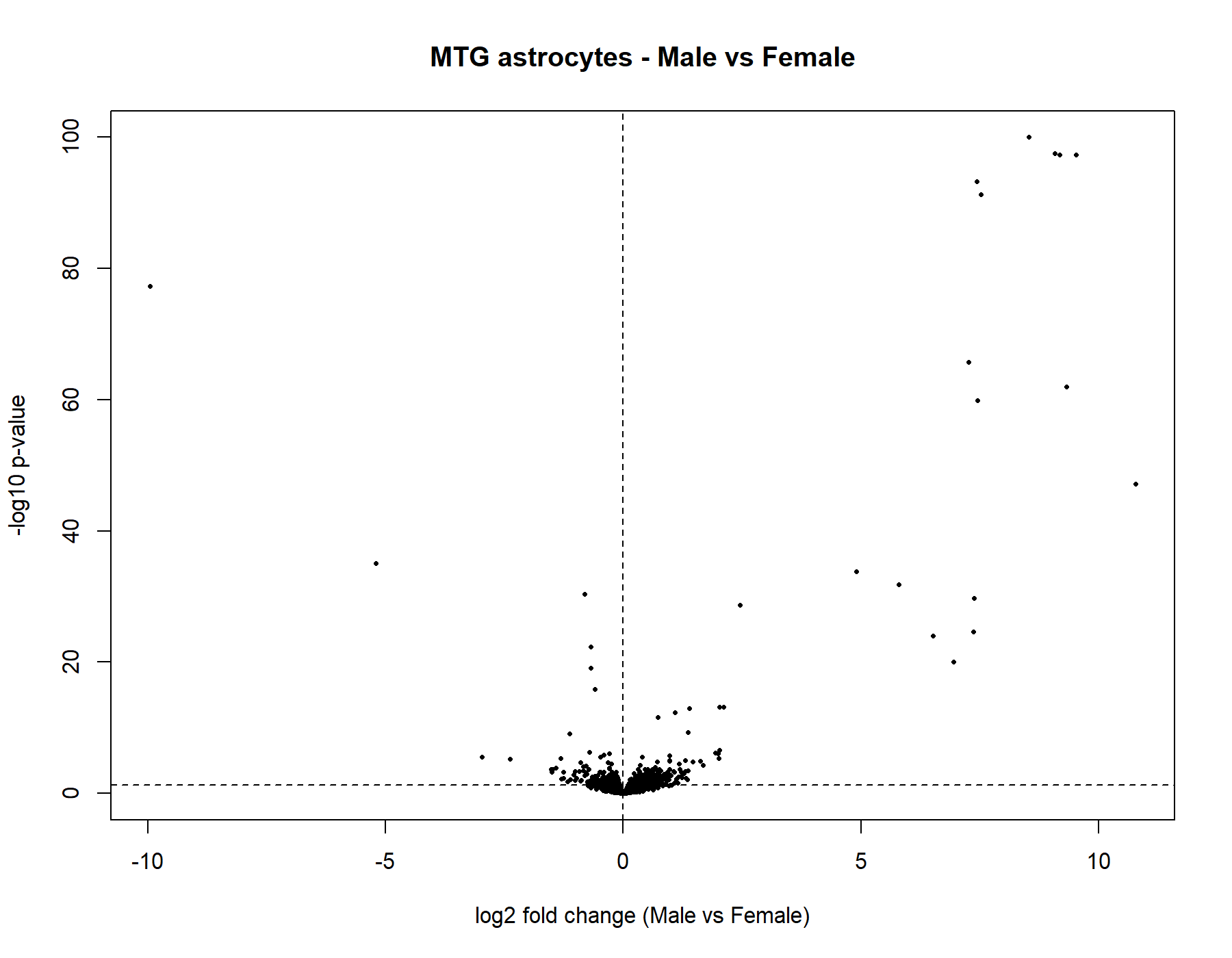
Most of them are on the sex chromosomes:
| Group | Genes |
|---|---|
| Y-linked, higher in males (15) | USP9Y, UTY, DDX3Y, KDM5D, EIF1AY, RPS4Y1, ZFY, ZFY-AS1, NLGN4Y, PCDH11Y, PRKY, TMSB4Y, TTTY14, TTTY10, LINC00278 |
| Pseudoautosomal, higher in males (4) | CD99, PLCXD1, GTPBP6, ZBED1 |
| X-linked, higher in females (13) | XIST, TSIX, JPX, KDM5C, KDM6A, ZFX, ZFX-AS1, USP9X, PUDP, ZC3H12B, PIN4, EIF2S3, SMC1A |
| Annotated autosomal, higher in males | CD24, TRIM5, IL27, HMOX1, CD74, HLA-DRA, HLA-DRB1, NIBAN1, COL9A3, DDX43 |
| Annotated autosomal, higher in females | DACH1 |
The remaining 17 are lncRNAs and unnamed clone-based transcripts (for example AC012078.2 or AL353804.1) whose location was not looked up.
For enrichment, 12 of the 60 gene symbols could not be mapped by org.Hs.eg.db, and only 25 of the 39 male-higher genes had any GO Biological Process annotation. Among those, 114 GO terms were enriched, all related to immune function: antigen processing and presentation, T cell activation and differentiation, lymphocyte proliferation. No term was enriched among the female-higher genes.
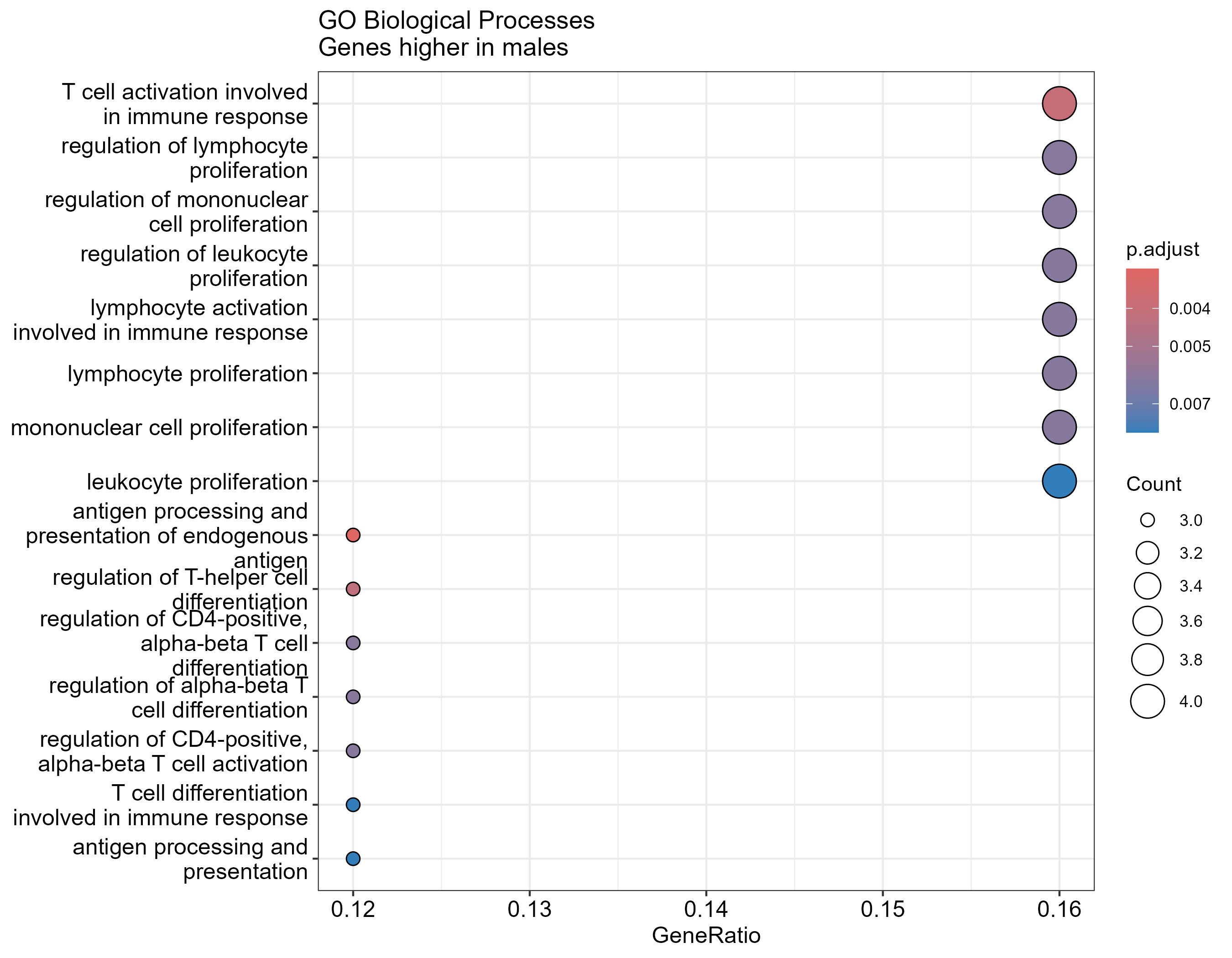
Emilia then counted how often each gene appears across the 114 terms. HLA-DRB1 is in 99 of them.
Caveats
- Most of the signal is the expected one. At least 32 of the 60 genes are on the X or Y chromosome or in the pseudoautosomal region. Finding them shows the pipeline and the sex labels are right, which is worth knowing, but it is not a finding about astrocytes or Alzheimer’s disease.
- The immune enrichment rests on five genes. HLA-DRB1, HLA-DRA, CD74, IL27, and CD24 carry every top term, and the 114 terms are largely the same few genes counted under overlapping labels. The number of enriched terms says little about how broad the signal is.
- Those genes may not come from astrocytes. MHC class II genes and CD74 are typical of microglia, and here they are expressed at low levels. Ambient RNA or a few mislabeled nuclei in some donors could produce the same result. This was not checked.
- HLA-DRB1 is a difficult gene to quantify. It is highly polymorphic, so read mapping differs between donors with different alleles, and a handful of donors can drive a group difference.
- The model is minimal. Only Braak stage was adjusted for. Age at death, post-mortem interval, RNA quality, and the number of nuclei behind each donor’s profile were not.
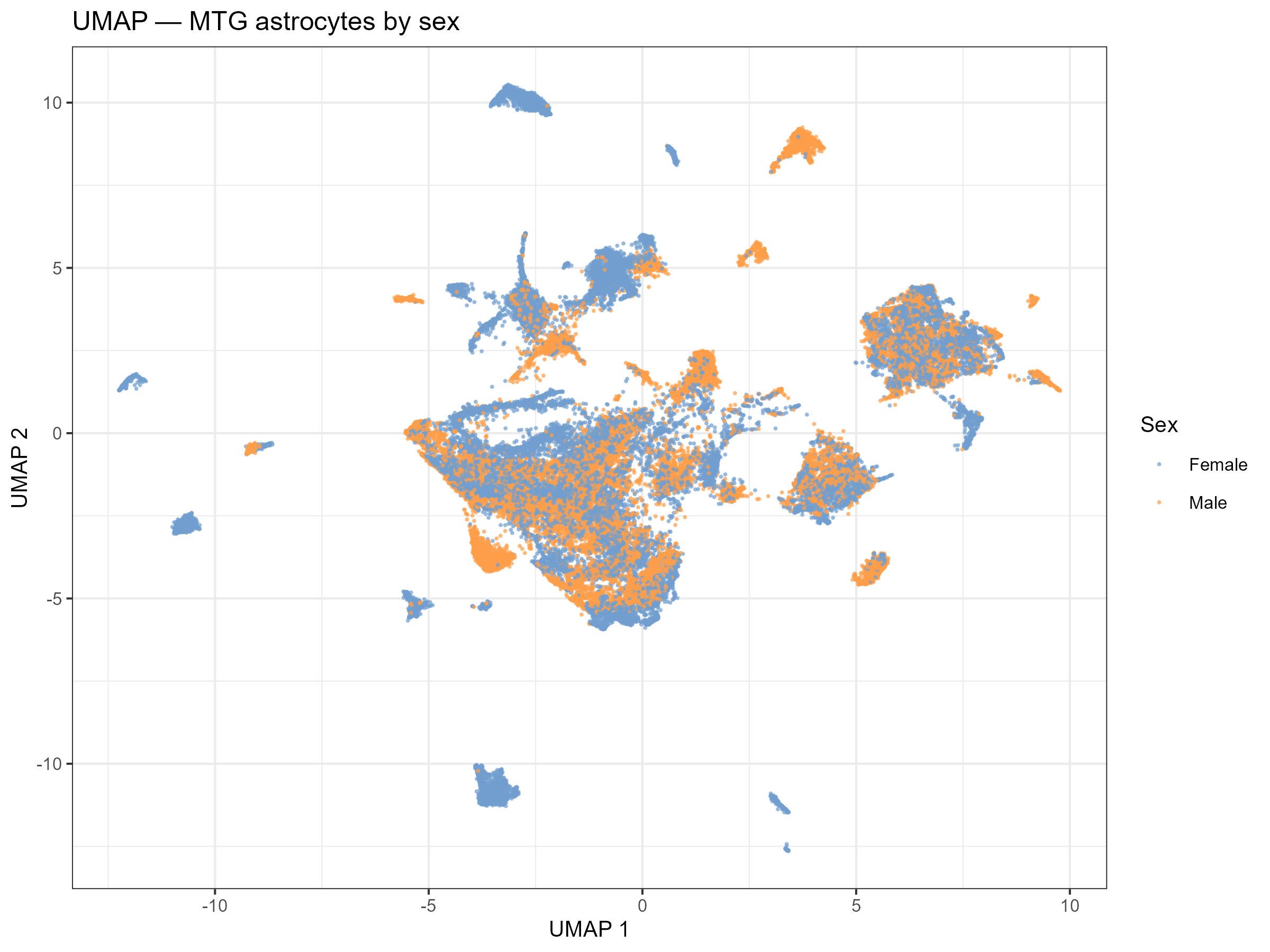
- The UMAP shows donor structure. Several clusters contain nuclei of one sex only, which is what you see when clusters are single donors and the donors were not integrated. This doesn’t affect the pseudobulk test, but don’t read those clusters as astrocyte subtypes.
Next steps
If you pick this up:
- Set the sex-chromosome genes aside and look at the autosomal list on its own. Then rerun the enrichment without them.
- Plot the HLA-DRB1, HLA-DRA, and CD74 pseudobulk values per donor. Is it a shift across males, or a few donors?
- Check for microglial contamination: do the donors with high MHC class II expression in “astrocytes” also show other microglia markers there?
- Add covariates (age, post-mortem interval, number of nuclei per donor) and see which genes survive.
- Test the question the project set out with more directly: does the effect of pathology differ by sex? That is a
Braak × Sexinteraction, not the main effect of sex. - Repeat in the prefrontal cortex donors. A real sex difference in astrocytes should show up in both regions.
Materials
The scripts (01 to 08, one per step above), the full result tables, and Emilia’s 45-step analysis plan are in the ipre-projects repository. Its README says how the scripts fit together and what to fix before running them.